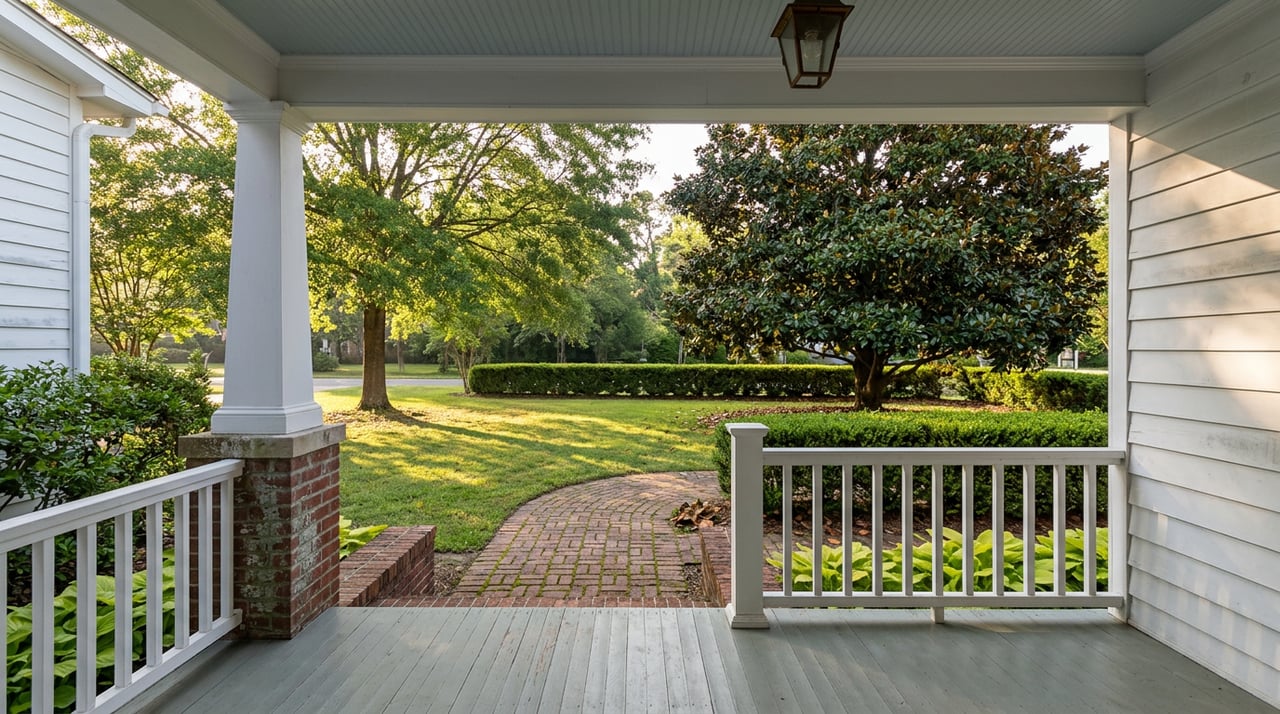
Pull up Marietta's median home price this summer and you'll see a market that's barely moving. Depending on which tracker you check, the citywide number lands somewhere between $435,000 and $530,000, with year-over-year change sitting in the low single digits, sometimes even slightly negative. That's the kind of number that makes a buyer relax a little. Flat markets feel safe. Flat markets feel like you have time.
Then you look at listings inside the Church Street-Cherokee Street Historic District, the walkable pocket of bungalows and cottages steps from Marietta Square, and the math stops working. One tracker has the median sale price there at $1.1 million as of the three months ending May 2026, up 35.7% year over year. Another has it at $740,000 over the trailing twelve months, up 51%. A third lists the median asking price in August 2026 at $1.39 million. Those three numbers don't agree with each other, and that disagreement is itself worth sitting with for a second. But they all point the same direction, and it's not a direction the citywide median hints at.
Marietta isn't one market moving at one speed. It's a flat market wrapped around a pocket that's accelerating hard, and if you're comparing neighborhoods right now, the citywide headline is close to useless for the decision you're actually making.
The gap between two numbers
Here's the comparison side by side, using the most recent windows each source reported:
| Citywide Marietta | Church Street-Cherokee Historic District | |
|---|---|---|
| Median price | $435,000-$530,000 (varies by source, 2026) | $740,000-$1.39M (varies by source, 2026) |
| Year-over-year change | Roughly flat, low single digits | 35.7% to 51% increase |
| Days on market | Upper 40s to low 50s | 26 to 45 days |
| Walk Score | 36 citywide | 77 for downtown Marietta |
That last row is the one I'd sit with longest. A citywide Walk Score of 36 describes a place built for cars, which is most of Marietta. A 77 describes a place where you can run actual errands on foot. Both numbers are true at the same time, because they're describing different footprints of the same city. The mistake is treating the citywide figure as if it tells you anything about life two blocks from the Square.
Why the historic core can't build its way out of demand
The rest of Marietta has an answer when demand rises: build more. Traton Homes added townhome inventory this year at Bluffs at Bells Ferry, a gated community off Bells Ferry Road. New listings citywide climbed to 267 in one recent 30-day snapshot, more than 11% above the same window a year earlier. When a neighborhood can absorb new supply, prices have somewhere to release pressure.
The historic district doesn't have that release valve. It was designated a locally protected historic district in 2016, and exterior changes there go through the city's Historic Board of Review rather than a standard permit desk. Lots are small and mostly already built out with homes dating to the late 1800s and early 1900s. I've seen listings in the district note that a parcel sits in the overlay district and could theoretically be divided, which tells you subdividing there is possible but not routine. You're not going to see a 40-unit infill project land on Cherokee Street the way you would off Bells Ferry Road.
So demand keeps rising against a supply that can barely move, and the price reflects that mismatch far more than it reflects the broader Cobb County market.
What's pulling harder on that supply right now
If you want to know why demand for that pocket keeps climbing in 2026, look at what's landed around it this year. El Jalisco opened August 25 at Marietta Square Market, bringing another sit-down option into the food hall a short walk from Church Street. Asher & Rose Grocers, a market-and-café concept from longtime Marietta restaurateurs Greg Lipman and Betty Bahl, opened in January in the space that used to house their restaurant Piastra. Deep Roots Wine Market and Tasting Room passed its health inspection with a perfect 100 in March, adding a wine-focused anchor a short walk from the historic district. Pisano's Pizzeria is still on track to move into the former Ahoy! There Be Dragons gallery space next to Willie Rae's Social House, and Antika, a new concept registered under BEJ Management LLC, passed its own food-service inspection with a 100 in April and is preparing to open on Powder Springs Street.
None of this is happening in a vacuum elsewhere in the city either. Casa Grande Bar & Grill opened in February on Franklin Gateway, and a 34-acre site on that same corridor has been moving through rezoning for a professional women's soccer training facility tied to AMB Sports and Entertainment, with hearings held back in the spring. That's a longer-horizon story for a different corridor, but it tells you Marietta as a whole has been absorbing serious investment this year. The historic core just happens to be where that investment concentrates hardest, because it's the part of the city that already has the bones for it: sidewalks, small storefronts, and a square you can walk to.
A correction, and what it teaches you about reading this data
While researching this, I ran into a widely repeated claim online describing a "113-home community planned for the greater Marietta Square area." That framing shows up in more than one place. The actual filing tells a different story. Reporting from the Marietta Daily Journal on the rezoning request placed the property along Interstate 75 near South Marietta Parkway and the Powers Ferry Hills neighborhood, several miles from the Square itself, and noted it's a scaled-down version of a larger 204-unit project the city had denied a few years earlier. It's a real project worth tracking, but it isn't evidence of building activity inside the historic core. It's evidence of the opposite: new supply keeps landing outside the district, not inside it.
That correction matters beyond nitpicking one blog post. When you're comparing neighborhoods from your couch, "near Marietta Square" gets used loosely enough that it can mean a mile away or five miles away. Before you let a stat move your decision, check what geography it's actually describing.
The same caution applies to the price figures I cited above. Three trackers, three different numbers, all describing the same fifty-some historic properties that trade in a given year. In a market that small, one $2 million estate sale or one $500,000 fixer can swing the median by six figures. Treat the direction as the signal and the specific dollar amount as a range, not a fact to quote back to a lender.
What this means if you're actually comparing neighborhoods
If walkability to the Square is the reason you're moving to Marietta at all, budget for a market that's going to keep outrunning the citywide average, because the constraint that's driving that gap (small lots, historic review, limited teardown potential) isn't going away. You're not buying into "Marietta." You're buying into a specific few blocks with their own physics.
If your priority is more square footage or more flexibility on price, the broader city is genuinely giving you room this year. Days on market citywide sit in the high 40s, new listings are up over last year, and price growth is modest enough that you're not fighting six other offers on everything you tour. That's a real advantage if you don't need to be in walking distance of Church Street.
Either path is reasonable. The mistake is comparing them using one median number that was never describing both of them in the first place.
A few common questions
Does this mean the rest of Marietta is a weaker investment? Not necessarily. It means it's a different kind of investment, priced for space and flexibility rather than walkability, in a market currently favoring buyers with more time to decide.
Will new construction outside the historic core eventually pull demand away from it and cool prices there too? Possibly over a longer horizon, but new subdivisions and historic bungalows aren't really competing for the same buyer. Someone choosing a 100-year-old cottage within walking distance of a wine bar isn't cross-shopping a gated community off Bells Ferry.
Is the Walk Score gap really that dramatic? Citywide Marietta scores 36, which reflects a city built mostly for driving. Downtown Marietta scores 77. Both are accurate. They're just measuring different footprints of the same city, which is the whole point of this piece.
If you're trying to figure out which version of Marietta actually fits how you want to live, that's not a conversation a portal median can have with you. I can. Richie Rich Atlanta puts together a custom marketing and search plan built around the specific blocks you're comparing, not the citywide average. Start with a free, custom marketing plan and let's figure out which few blocks are actually worth your budget.
